


Choosing a tent is one of the biggest design decisions in any outdoor wedding, and for couples planning a wedding in the United States today, the debate usually comes down to two very different-sounding options: the Frame Tent and the Raj Tent. On the surface, this looks like a classic apples-to-oranges comparison — a plain, modern structural tent versus an elaborately decorated, culturally rich pavilion. But once you dig into how each is actually built, the real answer is more interesting than that.
As it turns out, a Raj Tent isn’t really a different kind of structure from a frame tent at all. According to Indian Tents (indiantents.com), one of the leading manufacturers and exporters of Raj Tents worldwide, the Raj Tent is built on the exact same folding metal pipe frame, sockets, and base plates used in standard Western frame tents. The real difference isn’t in the bones of the structure — it’s in everything wrapped around those bones: the block print patterns, the mirror work, the jewel-toned canvas walls, and the centuries of Rajasthani royal history baked into the design.
That distinction matters enormously if you’re planning an Indian Style Wedding, a Big Fat Wedding with multiple days of celebration, or simply an American wedding that wants more color and character than a standard white tent can offer. This guide walks through exactly how a Frame Tent and a Raj Tent compare — structurally, aesthetically, and financially — so you can decide which one deserves a spot on your wedding day.
What Is a Frame Tent?
A frame tent is a self-supporting event structure built on an aluminum or steel frame rather than a system of tall center poles. Because the frame carries the entire load of the canopy, frame tents don’t need staking into soft ground the way traditional pole tents do, which means they can be installed on grass, gravel, asphalt, concrete patios, rooftops, and even indoors. This flexibility has made frame tents one of the most commonly rented tent styles for American weddings over the past two decades.
The defining structural feature of a frame tent is its clear-span interior. With no center poles interrupting the floor plan, couples get complete freedom to design their layout — round tables, a dance floor, a stage, a bar — without working around obstructions. That open floor plan, combined with the tent’s clean, straight sidewalls and peaked or gable roofline, gives frame tents a more modern, architectural look compared to the softer, sweeping silhouette of a classic pole tent.
Pricing for frame tents in the U.S. market generally runs higher than pole tents. Purchase prices for commercial-grade frame tents typically fall between roughly $8 and $15 per square foot, and rental packages for a standard wedding-size frame tent commonly range from around $1,000 to $5,000 depending on size, region, and add-ons, with larger or premium builds pushing well past that. Frame tents also tend to take longer to install and strike than pole tents, since assembling the rigid frame is more labor-intensive than raising a canopy over poles.
There’s one significant tradeoff couples run into again and again with a standard frame tent: the visible metal framework overhead. Because the structural bars are exposed on the interior ceiling, many couples feel the space reads as a little industrial or unfinished on its own. The typical fix is a fabric liner — a draped fabric ceiling installed to hide the frame and soften the room. The catch is that liners are expensive, frequently adding close to the cost of the tent itself, which means achieving a genuinely elegant, finished look inside a plain frame tent often requires nearly doubling your budget.
In short: a frame tent gives you excellent structural versatility and a clean, open floor plan, but out of the box, it’s a blank canvas — and finishing that canvas to wedding-day standard costs real money and time.
What Is a Raj Tent?
The Raj Tent traces its name directly back to Rajasthan, the desert kingdom of northwestern India renowned for centuries of royal patronage of art, textiles, and craftsmanship. According to Indian Tents, the kings and monarchs of Rajasthan historically camped in tents while hunting and traveling on excursion, and those tents were richly decorated with elaborate interiors and traditional block print patterns. The modern Raj Tent is a direct descendant of that royal camping tradition, reimagined as a luxury event structure.
Here’s the detail that reframes the entire Frame Tent vs Raj Tent conversation: Indian Tents describes its Raj Tents as “an exclusive range of our Indian Frame Tents.” In other words, a Raj Tent typically uses the same underlying architecture as a Western frame tent — folding metal pipe frames with sockets and base plates for stability — configured into shapes like the eight-sided Royal Octagon Tent, Marquee-style Raj Tents, and Square Cabanas. So a Raj Tent isn’t competing with the frame tent’s structural engineering at all. It’s built on it, and then dressed in centuries of Indian royal design tradition on top.
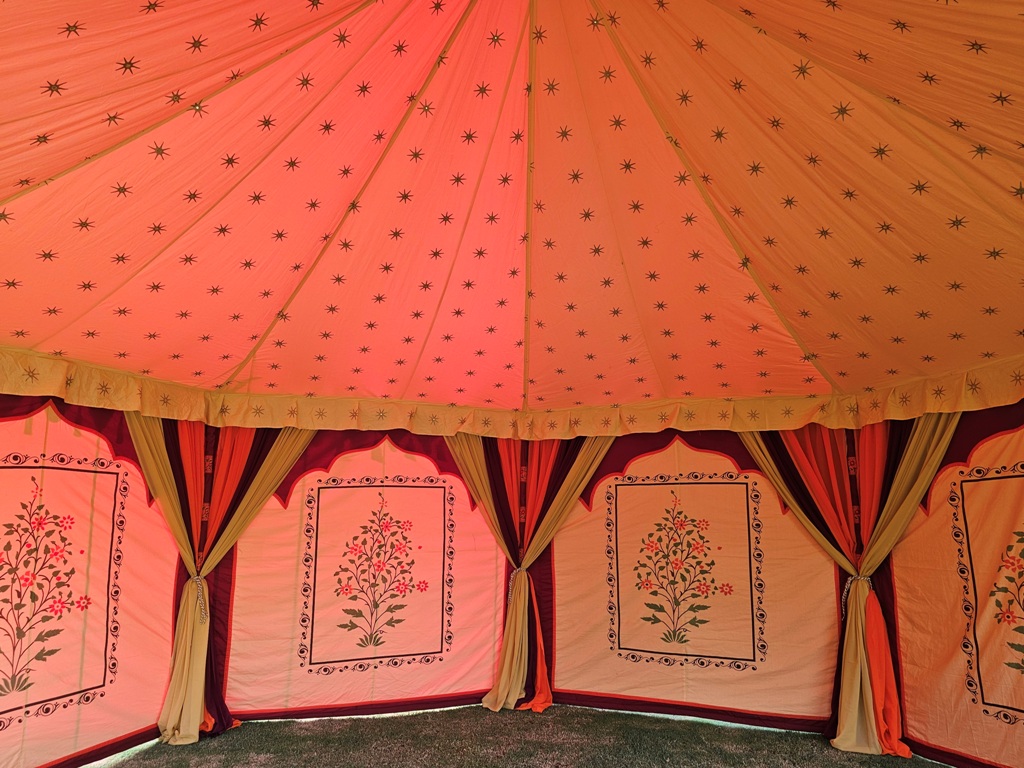
That design tradition shows up in nearly every visible surface of the tent. Raj Tents use a water-repellent cotton canvas top, typically left in a natural, undyed tone on the outside. Inside, the ceiling is where the drama happens — finished in rich royal blue, bright red, vibrant fuchsia, or bold orange, printed with gold star patterns and finished with delicate mirror work that catches candlelight and creates the effect of a starry, jewel-toned sky overhead. The walls mix solid canvas panels with sheer curtains: canvas for closing the tent off in winter or at night, and gauzy, breathable drapes for warm-weather daytime events when you want light and breeze moving through the space.
Raj Tents also come in a range of configurations built for different event needs. Smaller Cupola-style Raj Tents are self-standing units that can be joined together to create one large connected space for bigger gatherings — a particularly useful feature for a Big Fat Wedding spanning multiple ceremonies. Marquee Style Raj Tents, historically used by Rajasthani royalty for overnight stays during hunting trips, feature three sides of solid canvas walling with the front left open behind flowing sheer drapes tied back with decorative tassels, available in sizes like 3m x 3m and 4m x 4m for more intimate settings, or joined in larger multiples for grander events.
Perhaps the most practical advantage baked into the Raj Tent’s design is its customizability across multiple event days. The outer valance — the decorative trim along the tent’s roofline — is detachable, meaning couples can order two or three additional valance sets and completely change the tent’s color story from one event to the next without renting an entirely new structure. Pair that with matching curtain sets, and the same physical Raj Tent frame can transform from a soft yellow-and-marigold palette for a Mehndi to a jewel-toned fuchsia-and-gold look for a Sangeet, and back to an elegant ivory-and-gold palette for the wedding ceremony itself.
Frame Tent vs Raj Tent: Comparing the Two Head-to-Head
Once you understand that a Raj Tent is essentially a richly decorated evolution of the frame tent, the real Frame Tent vs Raj Tent comparison isn’t structure versus structure — it’s blank versus finished. Here’s how the two stack up across the factors that matter most to couples planning a wedding.
Structural Performance – Frame Tent vs Raj Tent
Both a standard Frame Tent and a Raj Tent share the same fundamental engineering advantages: a self-supporting metal frame, no center poles to interrupt the floor plan, and the ability to be installed on grass, gravel, decking, or hard surfaces where staking isn’t possible. Neither style requires the wide clearance zone that pole tents need for anchor ropes and stakes, which matters if your venue has a tighter footprint. On pure structural terms, there’s no real disadvantage to choosing a Raj Tent over a plain frame tent — you get the same clear-span versatility either way.
Aesthetic Impact – Frame Tent vs Raj Tent
This is where the two diverge sharply. A standard Frame Tent, left undressed, presents a plain white or ivory canopy with an exposed metal ceiling structure. It’s a genuinely blank canvas, which some couples want — but it requires additional styling investment (liners, draping, lighting, florals) to reach a finished, photo-ready look. A Raj Tent arrives with that finished look already built into the structure: colorful block print patterns, mirrored ceiling work, and a richly layered interior that doesn’t need a liner to feel complete. If your wedding vision leans toward color, pattern, and old-world opulence rather than minimalist white space, the Raj Tent delivers that out of the box.
Cost Efficiency – Frame Tent vs Raj Tent
On paper, a bare frame tent often looks like the more affordable option. But once you factor in the cost of a fabric liner — frequently adding close to the price of the tent itself to achieve a finished ceiling — the total investment required to make a plain frame tent look genuinely elegant can rival or exceed the cost of a Raj Tent, which comes with its decorative interior already engineered in. For couples comparing true final cost rather than base rental price, Raj Tents often represent better value once styling is factored in.
Cultural and Emotional Resonance
A Frame Tent is culturally neutral by design — a blank structure meant to disappear into whatever theme is layered on top of it. A Raj Tent carries genuine history and meaning, particularly for couples planning an Indian Style Wedding or any celebration that wants to honor South Asian heritage. The block print patterns, the mirror work, the royal color palette — these aren’t decorative add-ons chosen from a catalog; they’re a continuation of a design tradition that goes back centuries to actual Rajasthani royal encampments.
Flexibility Across a Multi-Day Wedding
This is one of the most practical differentiators for anyone planning a Big Fat Wedding. A standard frame tent is generally rented and styled once for a single event. A Raj Tent’s swappable valances and curtain sets mean the same physical structure can be restyled in a completely different color palette for each event across a multi-day celebration — the Mehndi, the Sangeet, the wedding ceremony, and the reception — without needing to source, deliver, and style multiple separate tent structures.

Photography
Because a Raj Tent’s interior is already richly decorated with pattern, color, and mirror work, it tends to photograph beautifully with minimal additional styling — the tent itself becomes a striking backdrop. A plain frame tent, by contrast, generally photographs best once a full design budget has gone into liners, uplighting, and florals; left undressed, it can read as flat or unfinished in photos.
Why Raj Tents Are the Better Fit for Indian Style Weddings
For couples planning an Indian Style Wedding in the U.S., the case for a Raj Tent goes beyond aesthetics — it’s about function matching tradition. Modern South Asian weddings in America typically span three to four condensed days of celebration (traditionally as many as five to seven), including events like the Mehndi, Haldi, Sangeet, the wedding ceremony itself, and the reception, often hosting anywhere from 150 to well over 500 guests across the week. Each of these events traditionally carries its own color story: soft yellows, oranges, and pastels for the Mehndi; bold jewel tones for the high-energy Sangeet; and rich, formal palettes for the wedding day itself.
A Raj Tent is built to move through exactly that kind of color choreography. Because the outer valance and curtain sets are detachable and interchangeable, families don’t need to book a completely different tent for each event — they can order additional valance and curtain sets in the colors each ceremony calls for, and transform the same Raj Tent structure from one night to the next. That’s a meaningful advantage for multi-day Indian Style Wedding celebrations, where budget and logistics are already stretched thin across several back-to-back events.
The visual language of the Raj Tent also does a lot of the cultural storytelling work automatically. Rather than layering South Asian design elements onto a neutral Western tent — florals here, fabric draping there — a Raj Tent’s block print patterns, mirror work, and royal color ceiling are authentically part of the structure’s Rajasthani heritage from the outset. For couples who want their tent to actively reflect their culture rather than simply host it, that distinction carries real weight.
Why Raj Tents Suit the “Big Fat Wedding” in America
The phrase “Big Fat Wedding” has become shorthand across the U.S. wedding industry for exactly the kind of large-scale, multi-day, guest-count-in-the-hundreds celebration that South Asian weddings are famous for — and increasingly, the term describes plenty of non-South Asian American weddings too, as couples across the board lean into bigger guest lists, more elaborate design, and multi-event wedding weekends.
A Big Fat Wedding puts real demands on a tent structure that a single-day American wedding simply doesn’t. You need a structure that can host several hundred guests comfortably, that can be reconfigured or restyled across multiple consecutive events, and that delivers a genuine “wow” factor without requiring a completely new design budget for every single night of the celebration. The Raj Tent’s Cupola system, where multiple self-standing units join together into one large connected space, directly answers the scale problem — families can combine as many units as needed to comfortably host a 300, 500, or 800-guest Sangeet or reception. Meanwhile, the swappable valance and curtain system answers the restyling problem, letting one investment in tenting serve an entire wedding weekend rather than just a single event.
Compare that to relying on a plain Frame Tent for a Big Fat Wedding: you’d either need to rent an entirely new tent (and pay for an entirely new liner and design package) for each event across the weekend, or settle for the same undressed look across every single night of the celebration. Neither option matches the variety and grandeur that a Big Fat Wedding calls for.

Colorful & Block Print Tents: The Signature Look of a Raj Tent
If there’s one phrase that captures what actually sets a Raj Tent apart from a standard Frame Tent, it’s this: colorful & block print tents. Block printing is a centuries-old Rajasthani textile tradition, in which hand-carved wooden blocks are used to stamp intricate, repeating patterns onto fabric — a technique still practiced by artisans across Rajasthan today. When that same block print tradition is applied to a tent’s canvas walls and ceiling linings, the result is a structure with genuine handcraft and pattern built into every surface, rather than a printed or mass-manufactured design.
Combined with the mirror work and gold star detailing used on Raj Tent ceilings, the overall effect is unmistakably different from a plain white frame tent. Guests walking into a Raj Tent aren’t looking at a blank space waiting to be decorated — they’re stepping into an environment that’s already telling a story through color and pattern. For couples who want their wedding tent to be a genuine design statement rather than a neutral backdrop, colorful & block print tents like the Raj Tent collection deliver that instantly.
When a Plain Frame Tent Still Makes Sense
To be fair to the Frame Tent, there are scenarios where the plain, undressed version genuinely makes sense. If your wedding aesthetic is intentionally minimalist or modern — clean lines, monochrome palettes, industrial-chic styling — a bare frame tent’s neutral profile might actually be the better foundation to build on, since it won’t compete with a pared-back design vision the way a richly patterned Raj Tent would. Frame tents are also a practical choice if your venue is a rooftop, parking lot, or paved courtyard where a completely blank structure is genuinely what you need before adding your own custom design elements from scratch.
Budget-conscious couples who don’t plan to invest in a liner may also find a bare frame tent’s lower base rental price appealing for a smaller, simpler celebration — as long as they’re comfortable with the visible frame overhead and a more utilitarian look. It’s worth remembering, though, that because a Raj Tent is built on the same frame architecture, it can do everything a plain frame tent can do structurally — hard-surface installation, clear-span layouts, reliable wind performance — while also delivering the decorative richness a standard frame tent simply doesn’t have on its own.
Cost Comparison: Frame Tent Plus Liner vs. Raj Tent
Understanding the true cost picture is essential to the Frame Tent vs Raj Tent decision. A standard rental-grade frame tent for a mid-size American wedding typically runs somewhere in the range of $1,000 to $5,000 depending on size and region, with complete packages including flooring, lighting, and climate control often reaching $5,000 to $20,000 or more. But that base tent price is only the starting point for a couple who wants an elegant, finished interior. Because the frame is visible from below, most couples end up adding a fabric liner to soften the space — and liners are notoriously expensive, frequently adding close to the cost of the tent rental itself to achieve a genuinely polished ceiling.
A Raj Tent flips that cost structure. The decorative ceiling, the mirror work, the block print detailing, and the color palette are part of the structure’s manufactured design rather than an add-on styling expense layered on afterward. For couples comparing final, all-in cost — tent plus the styling needed to make it wedding-ready — a Raj Tent frequently delivers a more finished, photo-ready result without the separate liner expense that a plain frame tent requires. And because the valance and curtain sets are interchangeable rather than single-use, families planning a multi-day Big Fat Wedding get additional value: one structural investment can be restyled across several events, rather than paying full styling costs from scratch for each one.
Real Wedding Scenarios: Frame Tent vs Raj Tent in Practice
It can help to picture how this decision actually plays out for real couples. Consider a few common scenarios U.S. wedding planners see regularly.
The single-day American wedding with a modern aesthetic. A couple planning one ceremony and reception, with a minimalist color palette of white, sage, and natural wood tones, is likely better served by a plain Frame Tent. The neutral structure won’t compete with their pared-back design vision, and since they’re only styling one event, the added cost of a liner is a one-time expense rather than something they need to repeat across multiple nights.
The Indian Style Wedding spanning a full weekend. A family planning a Mehndi on Thursday, a Sangeet on Friday, the wedding ceremony on Saturday, and a reception that evening needs a structure that can transform four times without four separate rental contracts. This is where a Raj Tent’s swappable valance and curtain system becomes not just a nice aesthetic feature, but a genuine logistical solution — one structure, several looks, across an entire Big Fat Wedding weekend.
The fusion wedding blending two cultural traditions. Increasingly common in the U.S., fusion weddings often want a space that feels warm and richly detailed for a Sangeet or reception, even when the couple isn’t planning a fully traditional Indian Style Wedding. A Raj Tent’s colorful & block print tents aesthetic works well here because it reads as globally inspired and celebratory rather than tied to any single, narrow tradition — an easy visual fit for couples blending backgrounds.
The backyard or rooftop wedding on a hard surface. For couples working with a paved patio, rooftop, or driveway rather than open lawn, both a Frame Tent and a Raj Tent perform equally well, since both rely on the same frame-based engineering rather than ground staking. The choice here comes down entirely to aesthetic preference rather than site constraints.

Setup, Delivery, and Working With a Tent Provider
Regardless of which structure you choose, a few practical considerations apply to both Frame Tents and Raj Tents. Because both styles rely on a rigid frame rather than tall center poles, installation typically takes longer than a simple pole tent — plan for your tent provider to need access to the site a day or more in advance for larger installations, particularly for a Big Fat Wedding with a joined, multi-unit Raj Tent configuration.
It’s also worth confirming early what’s included in your quote. As with any Frame Tent rental in the U.S. market, the base structure is often just the starting point — flooring, lighting, sidewalls, and climate control are typically priced separately. The advantage of working directly with a Raj Tent manufacturer like Indian Tents is that the decorative elements that would otherwise be a costly add-on for a plain frame tent — the block print walls, the mirrored ceiling, the color palette — come built into the structure itself, simplifying your planning and reducing the number of separate vendors and line items you need to coordinate.
For any multi-day Indian Style Wedding, it’s worth discussing valance and curtain swaps directly with your provider well in advance, since coordinating color changes between a Thursday Mehndi and a Friday Sangeet takes some scheduling — but it’s a far simpler logistical lift than sourcing, delivering, and styling multiple separate tents across the same weekend.
The Growing Popularity of Raj Tents in the American Wedding Market
Raj Tents aren’t a niche or unfamiliar concept in the U.S. event industry — they’ve become an established category in their own right, particularly across major American markets with strong South Asian communities and a broader luxury wedding scene, from California to the East Coast. Event planners specializing in South Asian weddings routinely reach for Raj Tents specifically because they solve a problem that a plain Frame Tent simply can’t: delivering an authentically Rajasthani atmosphere without needing to design that atmosphere from scratch for every event.
Part of what’s driving this growth is the broader shift in American wedding culture toward bigger, more design-forward, multi-day celebrations. Even couples with no South Asian heritage have increasingly embraced the “Big Fat Wedding” model — welcome parties, rehearsal dinners with real production value, and receptions that stretch late into the night with multiple mood and lighting changes. That shift has made the Raj Tent’s built-in flexibility — its ability to be restyled across multiple events without becoming an entirely new rental — relevant to a much wider slice of the American wedding market than just Indian Style Weddings alone.
There’s also a growing appreciation in the broader event design world for handcraft and authenticity over mass-produced decor. As more couples move away from generic all-white tent aesthetics and toward spaces with real texture, pattern, and story, colorful & block print tents like the Raj Tent collection are increasingly being requested not because a couple is having an Indian Style Wedding, but simply because they want their tent to look and feel like nothing else at their venue that season.
Sourcing Your Raj Tent: What to Look For
If you’ve decided a Raj Tent is the right direction for your wedding, a few factors are worth confirming with your manufacturer or supplier before booking:
Authentic block print and mirror work. Ask whether the interior detailing is genuinely block-printed and hand-finished, as traditional Raj Tents are, rather than a printed imitation of the pattern — the difference shows up clearly in person and in photos.
Valance and curtain customization options. If you’re planning a multi-day Indian Style Wedding, confirm how many valance and curtain sets are available and how far in advance they need to be ordered, since custom colorways for a Mehndi, Sangeet, and reception may need extra lead time.
Sizing and joinability. Make sure the specific Raj Tent configuration you’re considering — Cupola, Marquee style, or Royal Octagon — can be sized or joined to comfortably fit your actual guest count, particularly for a large Big Fat Wedding with several hundred guests.
Weather-appropriate wall options. Confirm your tent includes both solid canvas walls for cooler or nighttime events and sheer curtain options for warm daytime celebrations, so the same structure performs well regardless of when each event on your wedding weekend is scheduled.
Export and delivery logistics. Since many premium Raj Tents, including those from Indian Tents, are manufactured internationally and exported to the U.S., confirm delivery timelines well ahead of your wedding date to avoid any last-minute scheduling pressure.
Choosing Between Frame Tent and Raj Tent: A Practical Checklist
A few questions can help clarify which direction makes the most sense for your wedding:
Do you want color and pattern, or a blank canvas? If your vision includes rich color, cultural detailing, and a photo-ready interior without a major separate styling budget, a Raj Tent is the more direct path there. If your vision is intentionally minimal or modern, a plain frame tent may be a better starting canvas.
Is your wedding spanning multiple days or events? If you’re planning a Mehndi, Sangeet, ceremony, and reception across several days — the hallmark of a Big Fat Wedding — the Raj Tent’s swappable valance and curtain system offers real logistical and financial advantages over renting and restyling separate tents for each event.
What’s your true all-in budget, including styling? Compare the full cost of a frame tent plus liner and decor against the cost of a Raj Tent, which arrives with its decorative interior already built in, before assuming the plain frame tent is the cheaper option.
How important is cultural authenticity to your celebration? For couples planning an Indian Style Wedding or wanting to honor South Asian heritage specifically, the Raj Tent’s roots in genuine Rajasthani royal tradition offer a level of authenticity a generic Western frame tent simply can’t replicate.
Do you need the structure to work on a hard surface? Both options handle this equally well, since Raj Tents share the same frame-based engineering as standard frame tents.

Frequently Asked Questions
Is a Raj Tent actually a type of frame tent? Yes. According to Indian Tents, Raj Tents are manufactured as an exclusive range within their Indian Frame Tents line, using the same folding metal pipe frame, socket, and base plate system as a standard Western frame tent, then finished with Rajasthani-inspired block print patterns, mirror work, and rich interior coloring.
Can Raj Tents be used for weddings that aren’t Indian or South Asian? Absolutely. While Raj Tents are rooted in Rajasthani royal tradition and are especially popular for Indian Style Weddings, their colorful, boho-royal aesthetic has become a popular choice for American weddings of many backgrounds that want a warmer, more richly decorated alternative to a standard white tent.
How much does a Raj Tent cost compared to a standard Frame Tent? Base pricing is comparable to other premium frame-style tents, but because Raj Tents include decorative interior detailing as part of their manufactured design, couples often spend significantly less on top of the tent itself compared to a plain frame tent that requires a separate liner to achieve a similarly finished look.
Can a Raj Tent handle different seasons and weather? Yes. Raj Tents are designed with a mix of solid canvas walls for winter and nighttime use and sheer curtains for warm-weather daytime events, and the tent top itself is made from water-repellent cotton canvas.
What sizes do Raj Tents come in? Smaller Cupola and Marquee-style Raj Tents are commonly available in sizes like 3m x 3m and 4m x 4m, and because individual units are designed to join together, they can be combined into much larger connected spaces for big weddings and multi-day celebrations.
Can I change the look of my Raj Tent between different wedding events? Yes, and this is one of its biggest practical advantages. The outer valance is detachable, and couples can order additional valance and curtain sets to completely change the tent’s color palette for each event across a multi-day wedding, without needing an entirely new tent structure.
Are Raj Tents available for purchase or rental in the USA? Yes. Indian Tents manufactures and exports Raj Tents to the United States and other markets worldwide, working with couples, planners, and venues directly.
Final Verdict: Frame Tent vs Raj Tent
When you strip away the surface-level comparison, the real Frame Tent vs Raj Tent decision isn’t a choice between two competing structural systems — it’s a choice between a blank canvas and a finished masterpiece built on the same reliable frame. A plain Frame Tent gives you flexibility and a clean, modern silhouette, but reaching a genuinely elegant, photo-ready interior means budgeting for liners and additional design work on top of the base rental. A Raj Tent starts from that same dependable frame architecture and arrives already dressed in centuries of Rajasthani craftsmanship — block print patterns, mirrored ceilings, and a color story that can shift from Mehndi to Sangeet to wedding day without ever changing the underlying structure.
For couples planning an Indian Style Wedding, a Big Fat Wedding spanning multiple days and hundreds of guests, or simply a celebration that wants color, pattern, and old-world romance built into the tent itself rather than added on afterward, the Raj Tent is the clear choice. It offers everything a standard frame tent offers structurally, plus the one thing a plain frame tent can’t provide on its own: a genuinely finished, culturally rich, photograph-ready space from the moment it goes up.
To explore Raj Tents for your wedding or event in the United States, visit indiantents.com.